Common Personality Patterns by Enneagram Type

In this post, we’ll explore common personality patterns for each Enneagram Type. I also include different patterns that you can try when you observe these common patterns that no longer serve you.
What are Personality Patterns?
In Enneagram theory, the goal is to move toward the essence of who we truly are and away from the personality shell we rely on to get through life. There’s nothing necessarily wrong with the shell: it’s helped us survive, and we’ve needed the behaviors and patterns to keep ourselves safe. However, when we’re ready to move toward growth, we have to start to let go of this shell.
Personality patterns are common behaviors or tendencies that reinforce and uphold the personality shell. We’ve often needed them, so we can have compassion for ourselves when we see them pop up, AND they’re often behaviors we need to observe and then let go of eventually.
When it comes to growth, we often see our patterns more, not less. This isn’t because we’re getting “less healthy” – it’s typically because we’re quicker to notice these patterns and how they’re keeping us stuck!
So if you see these patterns in your life, I invite you to get curious about them. How are they serving you? What other options might you have? Observation is the first step.
The patterns in this post are just a few I frequently see for each type. What else comes to mind when you think about this concept?
If you’d like to see what others of your type had to say, you can find it on Instagram and join the conversation! I’ll link the posts below!
Heart Types
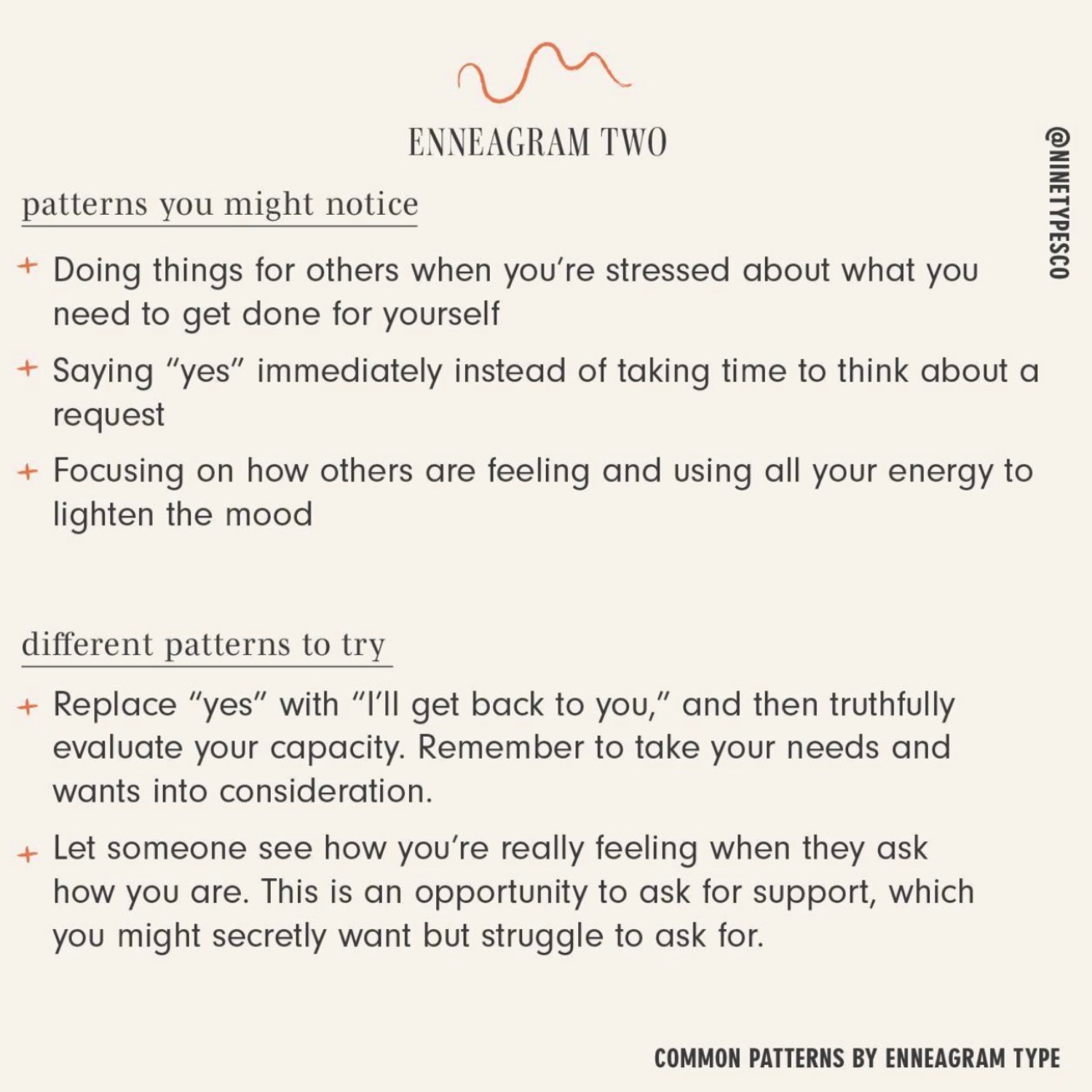
Type Two
Patterns you might notice
Doing things for others when you’re stressed about what you need to get done for yourself
Saying “yes” immediately instead of taking time to think about a request
Focusing on how others are feeling and using all your energy to lighten the mood
Different patterns to try
Replace “yes” with “I’ll get back to you,” and then truthfully evaluate your capacity. Remember to take your needs and wants into consideration.
Let someone see how you’re really feeling when they ask how you are. This is an opportunity to ask for support, which you might secretly want but struggle to ask for.
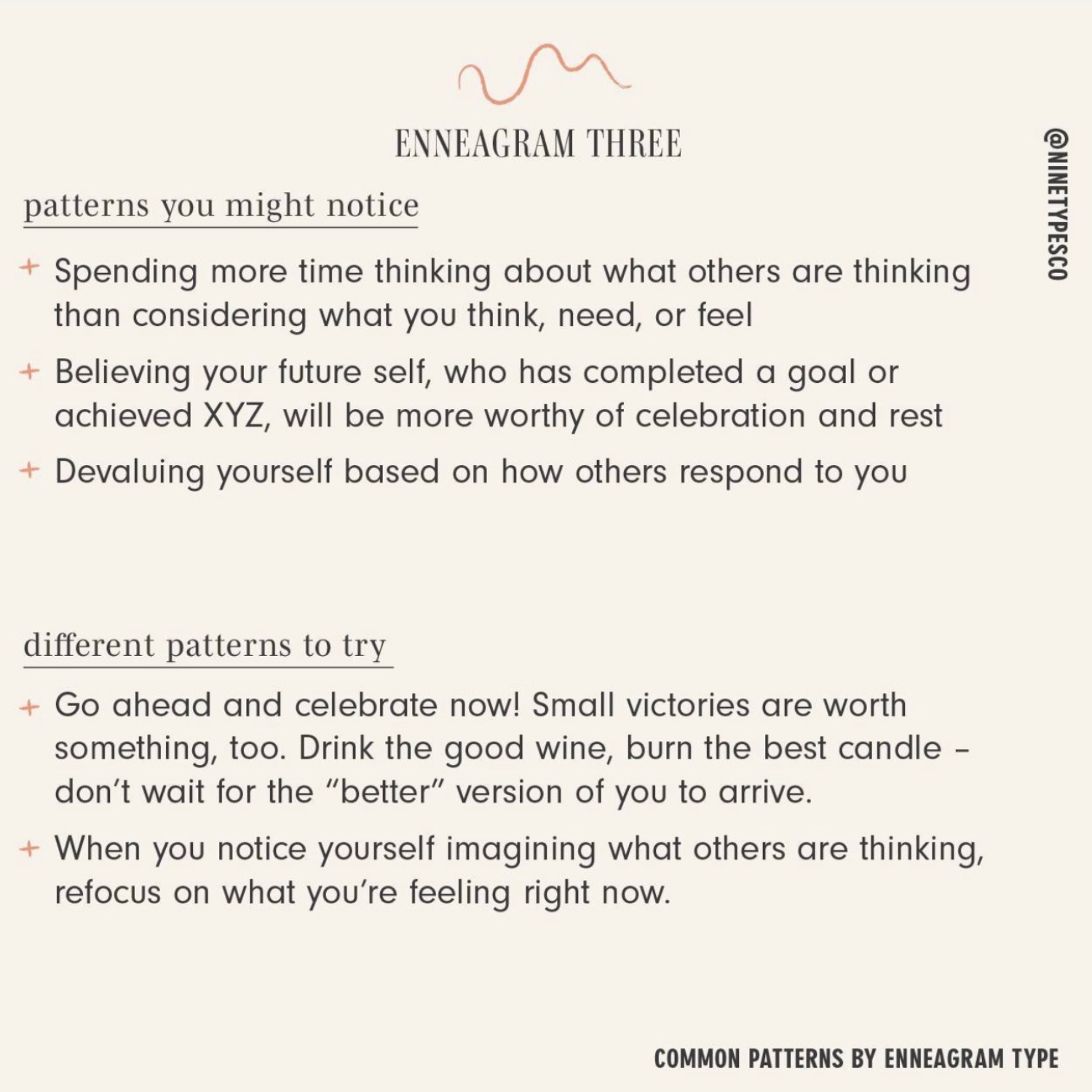
Type Three
Patterns you might notice
Spending more time thinking about what others are thinking than considering what you think, need, or feel
Believing your future self, who has completed a goal or achieved XYZ, will be more worthy of celebration and rest
Devaluing yourself based on how others respond to you
Different patterns to try
Go ahead and celebrate now! Small victories are worth something, too. Drink the good wine, burn the best candle – don’t wait for the “better” version of you to arrive.
When you notice yourself imagining what others are thinking, refocus on what you’re feeling right now.
Type Four
Patterns you might notice
Taking things very personally, especially when you’re already feeling down on yourself
Seeing what’s “missing” in you that prevents you from being as happy, whole, or “put together” as you perceive others to be
Feeling like you’re always on the edge of true self-knowledge or understanding, but not quite there yet
Different patterns to try
When you are swirling inside, reach out and help someone else. This can be a grounding experience that feeds your soul in a way that comparison never will.
Make up a story that has nothing to do with you. Example, “that guy cut me off because his wife is in labor and he’s on his way to the hospital!” Now it’s not personal, and you can wish him well versus feeling insulted.

Mind Types
Type Five
Patterns you might notice
Using your mind to maintain steadiness because being emotionally “off” feels so intolerable
Focusing on collecting all the information you need, which is an endless, anxious task because there’s always more to know
Avoiding feeling depleted by setting boundaries that are too rigid
Different patterns to try
Recognize where the feeling lives in your body, and let it be there for a while. Set a timer to be present with it for a few minutes, and then let it pass. (Tip: 5s, 6s, and 7s often describe this as “my head feels hot” or “my ears are burning”)
Bring the mental model into real life. Define a set amount of time to research and analyze, and then take one small action.
Type Six
Patterns you might notice
Searching for a sense of certainty but feeling like it’s always just out of reach
Always feeling like your “spidey senses are tingling,” even when you’re not cognitively processing a potential problem
Finding reasons not to trust others more easily than reasons to trust others
Different patterns to try
“Feel the fear and do it anyway” is a cliché for a reason! Try this approach when you are searching for certainty.
Take inventory of all the reasons to trust yourself and others. Use concrete evidence, like “I did this last time, and it worked out,” or “He showed up for me when he said he would.”
Type Seven
Patterns you might notice
Believing there’s nothing wrong with always looking for more excitement, fun, or possibility
Using your exuberance for what’s next to avoid feeling anxious (the more you do this, the more the cycle is ingrained)
Keeping yourself mentally stimulated at all times
Different patterns to try
Explore what you might miss by constantly moving. What could you learn by letting yourself get a little bit bored?
Move toward recognizing and dealing with your anxiety. This is typically a long process, and you may need professional help, but sometimes just acknowledging that it’s there can be a good start.


Body Types
Type Eight
Patterns you might notice
Pushing back on anything you don’t agree with without thinking about whether or not it needs to be said
Believing you can conquer your physical body by overcoming needs for sleep, rest, etc.
Naturally falling into an “all or nothing” mindset without even realizing it
Different patterns to try
Take a breath before responding or reacting. Being the first to speak up might be a way you’ve learned to defend yourself, but you have other resources now, which are more helpful as an adult.
Recognize when you’re doing the “all or nothing” thing, and question it. Does it have to be all or nothing? Or is there another way to look at the situation?
Type Nine
Patterns you might notice
Believing that disappearing into yourself will be easier (or less harmful) than showing up in your life
Going along with what others want because it seems like it will take too much energy to say something different
Not sharing when you disagree with a plan, and then doing your own thing without discussing it
Different patterns to try
Remember: you don’t exist to make life easier for others. You are a full person, with plans, hopes, dreams, and desires of your own. You are worth showing up for.
Evaluate how much energy you spend “going along to get along.” Entertain the idea that it might actually be more mentally taxing to keep the peace than to communicate your desires and do your own thing.
Type One
Patterns you might notice
Becoming so focused on the details that tasks become more complicated or time-consuming than “necessary” because something could always be better
Getting attached to a specific routine or structure and not allowing yourself or others to step out of the box or be spontaneous
Creating unattainably high standards for yourself and others
Different patterns to try
Recognize that your efforts are enough. We know you have a tendency to go above and beyond, and this is admirable, but sometimes you overlook how well you’re already doing.
Extend compassion to yourself by imagining yourself as a young child who made an honest mistake. What might you say to comfort that version of you?


The patterns in this post are just a few I frequently see for the Heart, Mind, and Body types. If you’re looking for ways to address these patterns (especially if your old ways aren’t working!), be sure to grab my new book, Enneagram in Real Life. You can find the hardcover, ebook, or audiobook wherever books are sold!
What common personality pattern would you add to your own type? Let me know on Instagram. You can click the images below to head over to each type’s Instagram post!